Insights, Financial models
House hacking with an FHA loan: the lender tests that decide the deal
House hacking with an FHA loan on a duplex to fourplex: the 3.5% down payment, the self-sufficiency test, rental income credit and after-tax returns.
By Roman Cintula · · 5 min read

House hacking means buying a small multi-unit property, living in one unit and renting out the others so the tenants cover most of the mortgage. In the United States (US) it is one of the few ways to buy an income property with a small down payment, because owner-occupied loans are available on buildings of up to four units. Most spreadsheets for house hacking with an FHA loan, a mortgage insured by the Federal Housing Administration (FHA), stop at cash flow. The deal is decided earlier, by whether the loan is approved, and later, by what is left after tax. This article covers the tests a lender applies and the numbers worth checking before you make an offer.
Why one to four units is its own category
US mortgage rules treat a property with one to four units as residential. That opens the door to the same loan programs used for single-family homes: FHA loans, loans guaranteed by the Department of Veterans Affairs (VA) and conventional loans backed by Fannie Mae and Freddie Mac. Five units and up is commercial lending, with different loans and different underwriting.
The loan limits follow the same line. The Federal Housing Finance Agency set the 2026 baseline conforming limit at $832,750 for a one-unit property, with higher limits for two, three and four units and for high-cost areas. FHA sets its own limits by county. A duplex that fits under the limit in one county may not in the next, so check the limit for the county and the unit count before anything else.
The FHA route and the self-sufficiency test
An FHA loan allows a down payment as low as 3.5% for qualifying borrowers, on the condition that the buyer lives in the property. The cost is mortgage insurance: an upfront premium, usually added to the loan, and an annual premium paid monthly. Both belong in the monthly payment from the start, because they change what the owner actually pays.
Three- and four-unit properties face an extra hurdle that catches many first-time buyers. Under the FHA self-sufficiency test, 75% of the property’s rental income has to cover the full monthly payment of principal, interest, taxes and insurance. The 25% haircut stands in for vacancy and upkeep. A fourplex with $4,000 of monthly rent counts as $3,000, which passes against a $2,900 payment and fails against $3,100. In expensive markets, where prices have risen faster than rents, many triplexes and fourplexes fail this test at 3.5% down, and the only fixes are a larger down payment, a lower price or a different loan.
Conventional, VA and DSCR loans
A conventional owner-occupied loan needs more money down than FHA on most multi-unit purchases, but its private mortgage insurance can be removed once the loan balance falls far enough, which FHA insurance on a low-down-payment loan generally cannot. Eligible veterans can use a VA loan, which adds a funding fee in place of monthly mortgage insurance. For both, the lender counts part of the expected rent as income when testing the borrower’s debt-to-income ratio, commonly 75% of it.
Investors who will not live in the property have two main routes. A conventional investor loan needs a larger down payment and carries a higher rate. A debt service coverage ratio (DSCR) loan is underwritten on the property instead of the borrower: the lender sizes the loan so that rent covers the payment by a set ratio, and often adds a prepayment penalty that steps down over the first years. The BRRRR approach (buy, renovate, rent, refinance, repeat) combines a short-term purchase loan with a cash-out refinance, and adds its own tests, including how long the lender makes you wait before refinancing at the new value. The Canadian BRRRR guide covers how that strategy works north of the border.
What the owner really pays
The useful number for a house hacker is the net monthly cost of living in the building: the full payment, plus operating costs and a reserve for repairs, less the rent collected. Compare that with what the same person would pay to rent a similar home. A property can lose money as a pure investment in year one and still leave the owner better off than renting.
Be honest about operating costs. Property tax rates vary enormously between states and counties. Insurance, repairs, vacancy and a reserve for the roof and furnace all need a line. A model that shows positive cash flow only because it leaves out repairs is not showing cash flow.
Tax changes the return
US tax rules reward and penalize rental owners in ways a pre-tax model cannot show. Residential buildings are depreciated over 27.5 years, which shelters part of the rent. Losses from a rental are generally passive, with an allowance of up to $25,000 against other income for owners who actively participate, phased out as income rises. On sale, the depreciation claimed is recaptured and taxed, the remaining gain is taxed as a capital gain, and the unit the owner lived in may qualify for the home-sale exclusion. These rules are detailed and change over time, so confirm them with a tax adviser.
Running the numbers
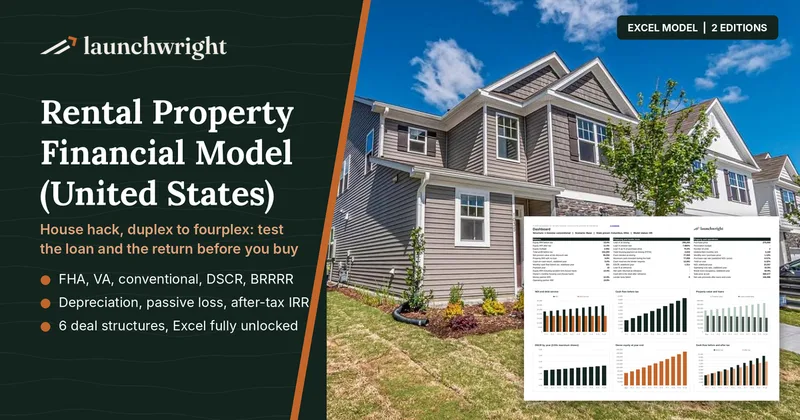
Launchwright’s US rental property model sets up the same property under six structures: an investor conventional loan, a house hack with FHA, conventional or VA financing, a DSCR loan and BRRRR. It applies the 2026 lender tests, including loan limits, the self-sufficiency test and debt-to-income with rental income credit, and the Due Diligence Edition adds after-tax returns. Its default case is a two-unit property in Columbus, Ohio bought for $275,000. With a 25% down investor loan, the template assumptions give an equity internal rate of return (IRR) of 13.4% before tax and 11.4% after tax, with cash flow of about $321 a month. Switched to an FHA house hack, the owner pays about $1,191 a month to live there, against $1,550 to rent elsewhere.
Those figures are illustrations from template assumptions. Canadian buyers face a different set of rules, covered in rental property analysis in Canada. If you are preparing a deal for a lender or a money partner, see what a lender-ready financial model looks like.
This article is general information, not mortgage, tax or investment advice. Loan program rules and limits change, so confirm them with a loan officer and a tax adviser.