Insights, Financial models
Rental property analysis in Canada: what US templates get wrong
Most rental property calculators are built for the US. Six Canadian rules change the answer, from mortgage compounding to CCA. Here is how to handle each.
By Roman Cintula · · 4 min read

Most of the rental property calculators you can find online were built for the United States. That matters more than it looks. A handful of Canadian rules change the monthly payment, the cash you need at closing, the tax you pay each year and what you keep when you sell. Get them wrong and a property that looks profitable may not be.
Six of those rules move the answer most. None of them is obscure, and a template built for another country has no reason to include any of them.
The mortgage itself works differently
The Interest Act requires a Canadian mortgage rate to be stated with its compounding period, and fixed-rate mortgages are almost always compounded semi-annually, not monthly. A template that compounds monthly overstates your interest slightly at every payment. Over a large mortgage and many years, that becomes real money. It also throws off your principal balance on the day you sell.
Put less than 20% down and the mortgage must be insured. The premium is added to the loan, and the premium rate rises as your down payment falls. Amortizations over 25 years carry an extra surcharge. In some provinces you also pay provincial sales tax on the premium, in cash, at closing. Insured mortgages are only available on properties up to a price cap, currently $1.5 million.
Insurance is what makes the house hack possible. You buy a duplex or a house with a legal suite, live in one unit and put down as little as 5% on the portion that qualifies. It also means your model has to carry the premium inside the loan and the tax inside your closing costs. Leave either out and the cash you need on day one is wrong.
Positive cash flow does not mean you qualify
To qualify, lenders test your income against payments at the higher of your contract rate plus two percentage points or 5.25%. Rental income from the property counts, but lenders do not count all of it.
So a model that shows positive cash flow does not tell you if you will be approved. Those are two separate calculations. Check qualification before you fall in love with a property.
Closing costs depend on where you buy
Land transfer tax ranges from nothing in Alberta, which charges only title registration fees, to substantial amounts in Ontario and British Columbia. Toronto and Montreal add their own municipal tax on top. A generic “closing costs: 2%” line can be far off in either direction. Look up the actual tax for the province, and for the city where it applies.
Tax while you own it and when you sell
In Canada, depreciation for tax is capital cost allowance, or CCA. On a rental you claim it on the building only, not the land, typically at 4% a year on a declining balance. Two rules catch people out. CCA cannot be used to create or increase a rental loss. And if you sell for more than the building’s depreciated value, the CCA you claimed is added back to your income as recapture, taxed at your full rate. Financing costs follow their own rule as well. You deduct them over five years, not in the year you pay them.
On sale, half of the gain is taxable at the current 50% inclusion rate. If you lived in one unit, that portion may qualify for the principal residence exemption. The rest does not. A model that applies one flat tax rate to the whole sale, or ignores tax on sale entirely, will overstate your return.
What the numbers look like in Calgary
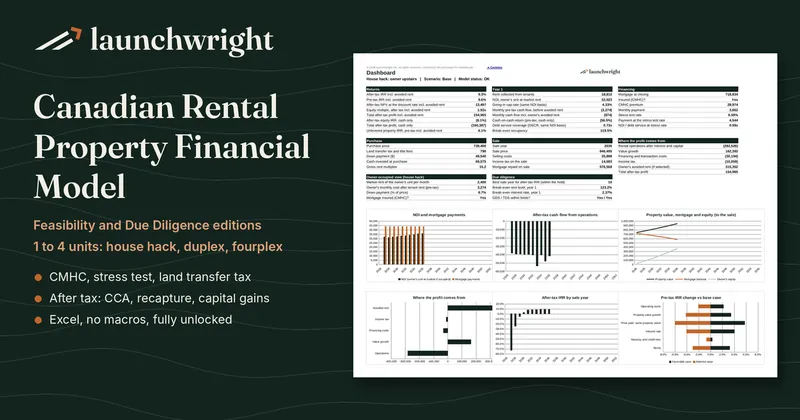
Launchwright’s rental property model starts from a Calgary detached house with a legal basement suite at the September 2026 benchmark price of $739,400, with current rents, vacancy, property tax and mortgage rates. At those defaults, an investor with 20% down loses money in the first year. That is the honest picture at current prices and rates.
Run the same property as a house hack, with the owner living upstairs, and it earns an after-tax return of about 9.6% a year over the hold, once you count the rent the owner no longer pays. Same building. Same market. The structure of the deal decides whether it works.
If you are buying five units or more, CMHC’s MLI Select program changes the financing completely, see whether the MLI Select points are worth it. And if your plan is to renovate and refinance, the BRRRR guide covers the 80% refinance cap.
A checklist for your next property
- Use semi-annual compounding for a fixed-rate mortgage.
- Add the insurance premium to the loan and any premium tax to closing costs.
- Test qualification at the stress test rate before you offer.
- Use the actual land transfer tax for your province and city.
- Claim CCA on the building only, never to create a loss, and plan for recapture on sale.
- Tax the sale properly, including the principal residence portion if you live there.
This article is general information, not tax, mortgage or investment advice. Rules change, so confirm them with your accountant and lender.