Insights, Financial models
Buying a business with an SBA 7(a) loan: the 2026 rules
Buying a business with an SBA 7(a) loan under the October 2026 rules: equity injection, seller notes, the 1.25 coverage test and how Canada differs.
By Roman Cintula · · 4 min read

Most small businesses change hands with borrowed money. A buyer puts in some equity, a bank lends most of the price, and the seller often leaves part of it in the deal as a loan. Whether the purchase works comes down to one question, which is whether the business’s cash flow can cover the debt and still pay the new owner a living. In the United States (US), the main financing route is the 7(a) loan guaranteed by the Small Business Administration (SBA), and its rules for acquisitions changed on October 1, 2026. This article covers what those rules require when buying a business with an SBA 7(a) loan, how Canadian deals are usually structured and the numbers to test first.
Start with the seller’s real earnings
Small businesses are usually priced on seller’s discretionary earnings (SDE): profit before interest, tax, depreciation and the owner’s own pay and personal expenses run through the business. It answers the question of how much cash the business produces for one working owner. The price is then a multiple of SDE that varies by trade, size and how dependent the business is on the seller.
The buyer’s job is to check the add-backs. Every expense the seller says was personal or one-time raises SDE and the price, and a lender will accept only the ones that can be documented. Normalizing three years of results, with each add-back supported, is the base for everything else.
The SBA 7(a) rules from October 2026
The SBA’s updated standard operating procedure (SOP), numbered 50 10 8.1, applies to loans approved on or after October 1, 2026. For a buyer acquiring a business, the main requirements are these:
- An equity injection of at least 10% of total project costs.
- A limit on how much of that injection can come from a seller note on standby or similar sources: together they cannot exceed half of the required injection.
- A debt service coverage ratio of at least 1.25 to 1, measured on the business’s historical or adjusted historical earnings. Projections cannot be used to meet the test.
- A business valuation for every change of ownership.
- A quality of earnings report when the purchase price, excluding owner-occupied real estate, is $3 million or more.
The seller can stay on as a consultant for up to 24 months. The loan term for a business purchase is generally ten years. These rules matter for price negotiations: because coverage is tested on what the business has already earned, a price justified only by the buyer’s growth plan will not qualify.
Seller notes and earn-outs
A seller note is a loan from the seller for part of the price. It reduces the cash the buyer needs and shows that the seller believes in the business. Lenders usually require it to be subordinated to the bank loan, and sometimes on standby, meaning no payments for a period. The terms decide how much it helps: a note that starts amortizing immediately adds to debt service in the hardest year.
An earn-out makes part of the price depend on future results. It bridges a gap between what the seller thinks the business is worth and what the buyer can prove. Earn-outs are common in conventional and Canadian deals, and loan programs set their own limits on them, so confirm with the lender whether one is allowed before building a deal around it.
How Canadian deals are structured
Canada has no direct equivalent of the 7(a) acquisition loan at the same scale. A typical structure combines a senior term loan from a bank, a subordinated loan from the Business Development Bank of Canada (BDC) or another junior lender, a vendor take-back (the Canadian term for a seller note) and the buyer’s equity. Each layer has its own rate, term and position, and the junior lenders are paid for the added risk.
Tax differs as well. Whether the deal is a purchase of assets or of shares changes what the buyer can write off and what the seller keeps after tax, and sellers of qualifying Canadian private company shares may be able to use the lifetime capital gains exemption, which is why they often prefer a share sale. Both sides need tax advice before the structure is fixed.
Year one is the hard year
Lender coverage is measured on the seller’s history. The buyer lives on the forecast. In the first year after a change of owner, some customers leave, the seller is paid for a handover, vehicles or equipment may need replacing and tax is due. A model should show both figures: the coverage a lender will calculate, and the cash the buyer will actually have after those deductions.
Seasonal businesses need a monthly view. A heating and cooling contractor does not earn the same in a mild month as in a cold snap or a heat wave, while loan payments stay level. A line of credit usually covers the gap, and the model should show how far it is drawn and when it is repaid.
Comparing structures on the same deal
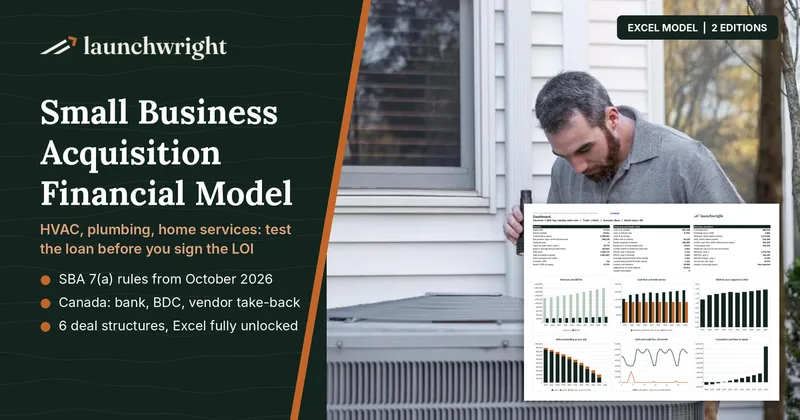
Launchwright’s small business acquisition model sets up the same business under six financing structures for the United States and Canada, including two SBA 7(a) structures, a conventional bank loan with a seller note and earn-out, and a Canadian bank loan with BDC and a vendor take-back. It runs by month with seasonality, applies the October 2026 SBA rules as pass or fail tests and shows the equity required, the lender’s coverage ratio, the lowest cash balance and what the buyer takes home under each structure.
If you are starting a business instead of buying one, see the Canadian small business startup plan. For what a lender expects to see in any model, read what a lender-ready financial model looks like. Preparing an acquisition for lenders is part of our capital readiness work.
This article is general information, not legal, tax or lending advice. SBA rules and lender policies change, so confirm them with your lender, lawyer and tax adviser.