Insights, Financial models
AI data center economics: what bringing your own power changes
AI data center economics when the campus builds its own gas power: grid or off-grid supply, colocation or GPU revenue, Alberta's levy and project debt.
By Roman Cintula · · 5 min read

Data centers have always needed land, fibre and cooling. For the large campuses now being built for artificial intelligence (AI), power has become the hardest thing to secure, and many developers are planning to generate their own. The International Energy Agency (IEA) estimated that data centres used about 415 terawatt-hours of electricity in 2024 and projected that figure to reach about 945 terawatt-hours by 2030. Grid connections on that scale can take years. Building a gas plant beside the campus, known as behind-the-meter power, gets a project running sooner, and it changes AI data center economics in ways a standard real estate model does not capture.
Two businesses in one project
A data center with its own power plant is two capital-intensive businesses joined together. The campus earns money by leasing powered space or computing capacity. The power plant exists to supply it, with its own capital cost, fuel bill, maintenance schedule and reliability. Most templates model one side and treat the other as a single line: a power price for the data center, or a customer for the power plant. The return on the combined project depends on how the two interact, so they need to be in one model.
Grid, hybrid or off-grid
There are three broad supply arrangements. A grid-only campus buys all its power from the utility and waits for the connection. A hybrid campus generates its own power and keeps a grid connection for backup or to sell surplus. An off-grid campus relies entirely on its own plant.
Each has consequences. Without the grid as backup, the plant needs spare generating units so that maintenance or a failure does not take the data center down, and that reserve margin adds capital cost. A grid connection reduces the spare capacity needed but brings connection charges, standby fees and, in some places, taxes or levies tied to grid use. Fuel supply has to be as reliable as the data center’s customers expect the power to be.
Choosing the generation technology
The main options for on-site gas power are reciprocating engines, aeroderivative gas turbines and combined-cycle plants. Engines come in small units, start quickly and are easy to add in stages, at a moderate efficiency. Aeroderivative turbines are compact and fast to install. Combined-cycle plants are the most fuel-efficient and suit very large, steady loads, but they cost more and take longer to build.
The comparison is made on the levelized cost of power: capital cost, fuel at the plant’s heat rate, operation and maintenance, and periodic major overhauls, spread over the energy produced. That cost can then be set against the grid price and the price charged to tenants. The IEA report expects natural gas to supply a large share of the growth in data centre electricity demand, alongside renewables, so equipment lead times and gas supply terms deserve as much attention as the cost estimate.
How the campus earns money
In a colocation model, tenants lease powered space under multi-year contracts and install their own servers. Rent is usually priced per kilowatt of contracted capacity per month, and power is either passed through at cost or included in a fixed price. Lenders like long leases with strong tenants, and they look at the weighted average unexpired lease term as a measure of how long the contracted income lasts.
In a GPU-as-a-Service model, where GPU stands for graphics processing unit, the chip used for AI computing, the operator owns the computing hardware and sells computing time. Revenue per megawatt is much higher, but so is capital cost, and the hardware loses value quickly as newer chips arrive. Utilization and pricing are far less certain than a lease. The two models are different risk profiles and attract different financing.
Alberta’s rules
Alberta has positioned itself as a location for large data centres that bring their own power, and it has added a levy that affects the numbers. Under the Financial Statutes Amendment Act, 2025 (No. 2), a levy on computer hardware applies from December 31, 2026 to data centres drawing 75 megawatts or more. The rate is 2% for grid-connected data centres, 1% for those that are grid-connected but generate their own power, and nil for those that are fully off-grid. The levy is creditable against Alberta corporate income tax, so for a profitable taxpayer it works largely as a prepayment, while a project with little taxable income in its early years bears more of it as a real cost.
One point needs care in a colocation project. Tenants usually own the computing equipment, and how the levy is shared between landlord and tenant is a matter for the lease, so it should be an explicit assumption in the model.
Debt and returns
Lenders size project debt to cash flow at a target debt service coverage ratio, with a cap on debt as a share of cost, a reserve account and tests that restrict distributions if coverage falls. For a data center with its own plant, the cash flow depends on lease-up, power cost and plant availability together, so the downside cases have to move all three.
Be careful with terminal value. A large share of the return in many data center models comes from an assumed sale at the end. Showing the equity return with and without a terminal value makes clear how much of it depends on the cash the project actually produces.
Testing a project
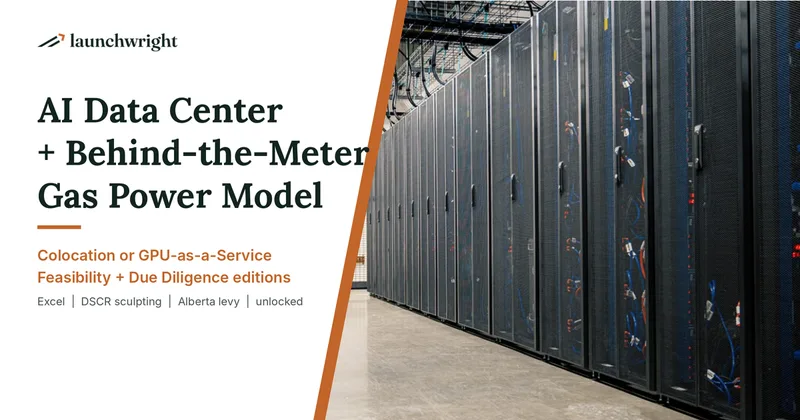
Launchwright’s AI data center model puts the campus and its gas plant in one file. It covers grid, hybrid and off-grid supply, the three generation technologies, plant ownership by the project or a third party, colocation leasing or GPU-as-a-Service, and presets for Alberta and Texas, with the Alberta levy as a switchable input. The Due Diligence Edition sculpts debt to a target coverage ratio and adds the reserve account, lock-up test and loan life and project life coverage ratios. Every default is cited to a public source or labelled as a template assumption.
For how large plant budgets go wrong, see pyrolysis plant capital cost, and for what lenders expect from a model, what a lender-ready financial model looks like. Deciding whether a project is worth developing is part of our strategy and project development work.
This article is general information, not investment, tax, legal or engineering advice. Confirm levy rules, grid requirements and tax treatment with qualified advisers.