Insights, Financial models
Hotel financial model: how lenders underwrite a hotel purchase
What a hotel financial model has to show a lender: seasonality by month, fixed costs, franchise fees and a loan sized by cost, DSCR and debt yield.
By Roman Cintula · · 4 min read

A hotel is real estate with an operating business inside it. Rooms are sold one night at a time, revenue moves with the season and the economy, and a large share of the costs do not move at all. Lenders know this, which is why a hotel loan is underwritten more cautiously than a loan on an apartment or office building with leases in place. A hotel financial model that shows only annual averages misses the months that worry a lender most. This article covers how hotel performance is measured, what a pro forma has to include and how lenders size the loan.
The three numbers every hotel starts with
Hotel revenue begins with occupancy, the share of available rooms sold, and the average daily rate (ADR), the average price of a sold room. Multiply them and you get revenue per available room, or RevPAR, the number used to compare hotels of different sizes and to track one hotel over time. A hotel running 65% occupancy at a $140 ADR has a RevPAR of $91.
RevPAR alone says nothing about profit, so owners also watch gross operating profit per available room (GOPPAR) and net operating income (NOI). The industry reports all of this in a standard layout, the Uniform System of Accounts for the Lodging Industry (USALI), which separates departmental results such as rooms and food and beverage from undistributed costs such as administration, sales and marketing, maintenance and utilities. Lenders and buyers expect to see a pro forma in that layout.
Seasonality and the weakest month
Annual figures hide the pattern that matters for debt. A hotel in a summer destination can earn most of its profit in four months and lose money in winter, while its loan payment is the same every month. A model built by month shows whether NOI covers debt service in the slow season and how much cash has to be held back from the good months to get through the bad ones. Lenders look for this, and an owner who has not looked will find out in the first February.
Fixed costs and operating leverage
Many hotel costs are fixed in the short run: property tax, insurance, a core team, much of the energy bill and brand fees tied to systems. Others move with rooms sold, such as housekeeping labour, supplies and travel agency commissions. The split decides how hard a fall in rate or occupancy hits profit. Because the fixed costs stay, a 10% drop in revenue produces a much larger percentage drop in NOI. A model should carry a fixed and variable share for each cost line, so a downside case shows the real effect instead of scaling every cost with revenue.
The costs pro formas leave out
Four deductions are often missing from a first-time buyer’s numbers. Franchise fees, including royalties and marketing or reservation program fees, are charged as a share of rooms revenue on a branded hotel. Management fees apply if a third party runs the hotel, usually a base fee on revenue and sometimes an incentive fee on profit. A replacement reserve sets aside a share of revenue each year for furniture, fixtures and equipment. And commissions to online travel agencies and group bookers reduce what the hotel actually keeps from a booking. Lenders deduct all of these before they calculate NOI, whether or not the buyer has.
Branded hotels also come with a property improvement plan (PIP) on a change of ownership: a list of renovations the brand requires. The cost belongs in the purchase budget, and so do the rooms taken out of service while the work is done.
How lenders size a hotel loan
A hotel loan is typically the lowest of three limits. Loan-to-value or loan-to-cost caps the loan as a share of the price or the total budget. The debt service coverage ratio (DSCR) requires NOI to cover the annual loan payment by a set margin. Debt yield, which is NOI divided by the loan amount, has become a standard third test because it does not depend on the interest rate or amortization. A model should calculate all three and show which one binds, because that tells the buyer what would have to change to borrow more.
In the United States (US), smaller hotels are often financed through the Small Business Administration (SBA) 504 program, which pairs a bank first mortgage with a government-backed debenture. The standard structure is 50% from the bank, 40% from a Certified Development Company and 10% from the borrower, and the borrower’s share rises to 15% for a special-purpose property, a category that includes hotels and motels, and to 20% if the business is also new. Program limits and eligibility need to be confirmed with a lender.
Testing a deal
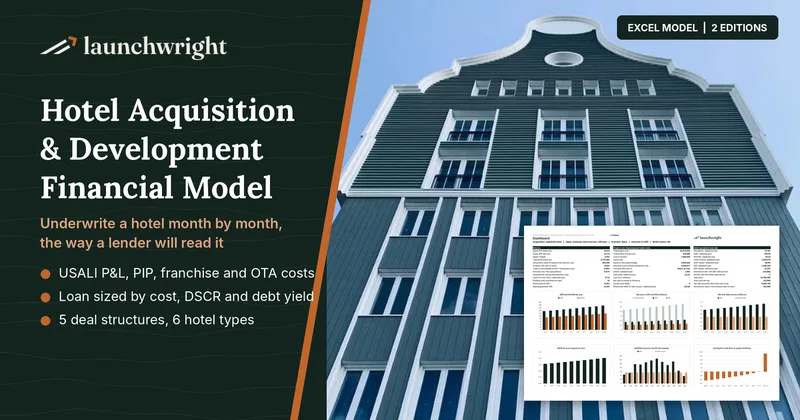
Launchwright’s hotel acquisition and development model runs one hotel by month for up to ten years across five structures: a stabilized purchase, a purchase with a PIP renovation, a purchase with a junior loan, ground-up development and a brand conversion. It uses the USALI layout, gives each cost line a fixed share and sizes the loan by cost, DSCR and debt yield. The default case is a 120-key select-service hotel in the United States bought at US$97,000 a key. On the template assumptions it shows an equity internal rate of return (IRR) of 15.0% before tax and a DSCR of 1.60 times, and it warns that NOI falls below debt service in three winter months. In that case, 57% of a rate-driven change in rooms revenue reaches NOI.
Those results are illustrations from template assumptions, and the presets are US figures, so a Canadian buyer should enter local rates and prices. For how lenders read a model more generally, see what a lender-ready financial model looks like, and for the yield measure behind the purchase price, cap rates explained. Preparing a deal for lenders and equity partners is part of our capital readiness work.
This article is general information, not investment, lending or tax advice. Confirm loan program rules and brand requirements with your lender and franchisor.