Insights, Real estate
Cap rate in Canada: how to calculate it and use it
Cap rate in Canada explained with worked numbers: building NOI properly, what to leave out, how it differs from cash-on-cash and IRR, and how rates move it.
By Roman Cintula · · 5 min read

This is for Canadian investors looking at their first apartment building or small commercial property, where the listing, the broker and the lender all talk in cap rates. A cap rate in Canada is calculated the same way as anywhere else: net operating income divided by price. Most of the mistakes come from the top half of that fraction, because a cap rate is only as good as the NOI behind it, and the NOI on a listing sheet is usually the seller’s version.
Calculating a cap rate in Canada starts with NOI
Net operating income is what the property earns in a normal year after running costs, before financing and income tax. Start from the rent the building would collect if every unit were let at current rents, add other income such as parking or laundry, and take off an allowance for vacancy and bad debt. That gives effective gross income. Then subtract every operating cost, including ones the current owner may not pay in cash, such as management (a self-managing owner still has the cost, it just goes unbilled) and a reserve for replacing appliances, flooring and boilers.
Take an illustrative example, with round numbers made up for the purpose: a six-unit walk-up with average rents of $1,650 a month.
- Rent at full occupancy $118,800, plus $1,200 of parking and laundry, for $120,000 of potential income
- Vacancy and bad debt at 3%, leaving effective gross income of $116,400
- Property tax $9,000, insurance $7,800, common-area utilities $6,000, repairs and maintenance $7,200, management at 5% $5,820, administration and snow clearing $1,780, and a replacement reserve of $1,800 ($300 a unit)
Operating costs come to $39,400, so NOI is $77,000. At an asking price of $1,400,000, the cap rate is 5.5%.
What to leave out of NOI
Mortgage payments stay out, both principal and interest, because the cap rate is meant to describe the property regardless of how a buyer finances it. Capital cost allowance and any other depreciation stay out, as does income tax. Large one-off capital projects, such as a new roof or a full window replacement, are also excluded from NOI itself, which is why the annual reserve matters. Some brokers and appraisers leave the reserve out as well, so when you compare cap rates across listings, check whether each one includes it.
Now look at the same building the way it is often marketed. Leave out vacancy, management and the reserve and the NOI rises to $88,220, which at the same price is a 6.3% cap rate. If 5.5% is the right cap rate for this kind of building in this city, the seller’s figure implies a value of about $1,604,000 against roughly $1,400,000 on the corrected number, a gap of around $200,000 that comes entirely from three line items. Before making an offer, I would rebuild the seller’s NOI line by line from the rent roll, the tax notice, an insurance quote and the utility bills.
Cap rate vs cash-on-cash vs IRR
On a financed deal these three measures can be far apart. Cap rate describes the property’s unlevered yield in year one. Cash-on-cash is the cash left after the mortgage payment, divided by the cash you put in. IRR is the annual return over the whole hold, including the sale.
Staying with the example: say the buyer puts 25% down and pays $20,000 in closing costs, so $370,000 of cash goes in, and borrows $1,050,000 at 5% over 25 years with semi-annual compounding, as Canadian fixed-rate mortgages normally are. Annual payments come to about $73,300, which leaves about $3,700 of cash flow and a year-one cash-on-cash return of roughly 1%. A 5.5% cap rate and a 1% cash return on the same building is a normal result when the mortgage rate sits close to the cap rate and principal repayment takes up much of what is left.
The IRR depends on what happens later. If NOI grows 2.5% a year and the building sells after ten years at the same 5.5% cap rate, less 3% selling costs, the before-tax IRR on the buyer’s cash is about 12%. Sell at a 6.5% cap rate instead and the sale price drops by about $276,000 and the IRR falls to about 9%. I would always run the exit cap rate at least half a point to a point above the purchase cap rate to see what that does to the return.
How cap rates move with interest rates
When borrowing costs and bond yields rise, buyers need a higher yield to justify the same purchase, and over time that pushes cap rates up and values down. The link is loose and slow, because cap rates also reflect rent growth expectations, the supply of buyers and how risky a given asset looks.
CBRE’s Canadian Cap Rates & Investment Insights report for Q3 2026, published in October 2026, put the national average cap rate across all property types at 6.56%, down 2 basis points from the previous quarter, while the Canada 10-year bond yield rose 62 basis points. The spread between the two narrowed to 256 basis points, which CBRE called a three-year low. In the Q2 2026 edition the spread had been 320 basis points, so most of the bond move was absorbed by the spread rather than by cap rates. The full report breaks cap rates down by city and asset class, which is useful as a check on your own figures but will not price a particular building.
Using a cap rate to value a property
Turn the formula around and value equals NOI divided by cap rate. Pick the cap rate from recent sales of comparable buildings in the same city and of similar age and condition, then apply it to your own NOI rather than the seller’s. Small differences in the cap rate move the value a long way. At $77,000 of NOI, a 5.25% cap rate gives about $1,467,000, and 5.75% gives about $1,339,000.
For houses, duplexes and fourplexes, lenders and appraisers mostly rely on comparable sales, so the cap rate there tells you whether the property pays for itself rather than what it is worth. What US rental templates get wrong in Canada shows a Calgary house with a legal suite losing money at 20% down. For five units and up, value follows NOI much more closely, and financing such as CMHC’s MLI Select is sized partly on whether NOI covers the debt.
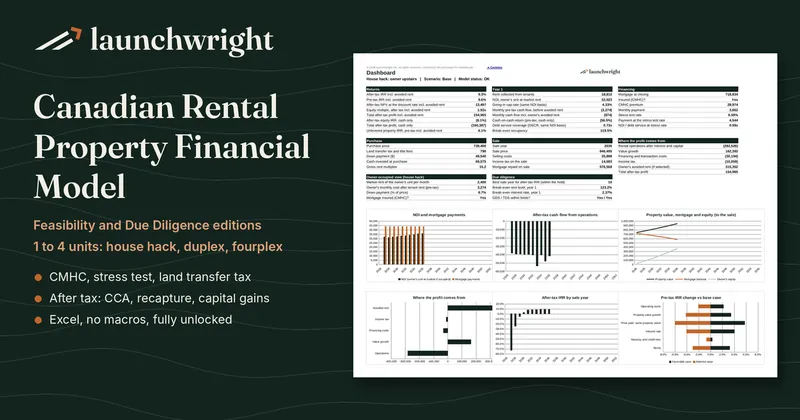
Having been part of a team that syndicated more than $100 million of Alberta commercial real estate, I would expect any investor or lender to ask how your NOI was built before they look at the cap rate. If you are raising money for an acquisition, that is part of our capital readiness work. For smaller properties, Launchwright’s Canadian rental property model builds NOI, cash flow and after-tax returns from the Canadian rules.
This article is general information, not investment, tax or appraisal advice.