Insights, Financial models
CMHC MLI Select: how to tell if the points are worth it
MLI Select trades bigger loans and longer amortization for affordable rents or energy work. Four tests show whether that trade pays on your building.
By Roman Cintula · · 4 min read

CMHC’s MLI Select is the most generous multi-unit financing in Canada. With enough points you can borrow up to 95% of the cost of a new rental building, amortize over as long as 50 years and pay a discounted insurance premium. The price is a commitment to affordable rents, energy savings or accessibility.
Most investors ask the wrong question about it. They want to know how much more they can borrow. What they should want to know is whether the extra debt earns more than a conventional or standard insured mortgage would, once you take off the rent you give up and the tax you pay. Those are different questions. The answer to the second one changes from building to building.
What the points buy
Affordability earns the most points. On an existing building, keeping 40%, 60% or 80% of units at affordable rents earns 50, 70 or 100 points. Commit for 20 years instead of 10 and you get 30 more. New construction has lower thresholds: 10%, 15% or 25% of units. Energy efficiency is worth 20, 35 or 50 points. Accessibility is worth 20 or 30.
Each tier improves the terms. According to CMHC, 50 points gets an existing building up to 85% loan-to-value and a 40-year amortization. At 70 points that rises to 95% and 45 years. At 100 points you get 50 years and limited recourse. New construction can reach 95% of cost at every tier, and the minimum debt coverage ratio for standard rental housing stays at 1.10 throughout.
“Affordable” has a precise meaning. Rent can be no higher than 30% of the median renter household income in your area, taken from CMHC’s own table, and annual increases are limited for as long as the commitment runs.
Which limit actually sizes your loan
An insured loan is sized on the lowest of several limits. One is loan-to-value, or loan-to-cost on a new build. The other is how much debt your net operating income can carry at the required debt coverage ratio, tested at a rate that may be higher than your contract rate.
When rates are high, the coverage test often binds first. If it does, the 95% you qualified for is theoretical. A longer amortization helps here, because it lowers the payment the income has to cover. Still, I would not count the extra leverage as a benefit until I knew which limit the building was actually hitting.
What the affordability commitment costs
Every affordable unit is rent you do not collect, every year of the commitment. To price that honestly, compare affordable rent with market rent unit by unit and year by year, then discount the gap back to today. Where median renter income is high relative to market rents, the gap can be small. Where it is low, the gap can wipe out the benefit of the cheaper debt.
The cap compounds, too. Affordable rents can only rise by the permitted amount each year, and in some provinces that amount is very low. CMHC publishes the figures. Alberta’s for 2027 is 0.1%. Set that against market increases for ten years and a small annual gap turns into a large one.
The cheapest route to your points
There is usually more than one way to reach a tier. You can get there on affordability alone, or on affordability plus an energy upgrade. Energy plus accessibility can reach 50 points with no affordable units at all.
The routes cost different things. Affordability costs you lost rent. Energy and accessibility work cost you capital. The right route is the one that reaches the tier you need at the lowest cost to your after-tax return, and that is often not the one that looks simplest on the application.
After tax, through to the sale
Cheaper debt raises cash flow. More debt means less equity in. Both push up your return on equity. Tax pulls the other way, in places people tend to skip. Interest is deductible and rent is taxable, and the insurance premium and financing costs are deducted over five years rather than all at once. When you sell, you face recapture of capital cost allowance and tax on the capital gain, currently at a 50% inclusion rate. Sell inside the affordability commitment and the buyer inherits it, which can affect your exit price. A comparison that stops at year-one cash flow misses most of this.
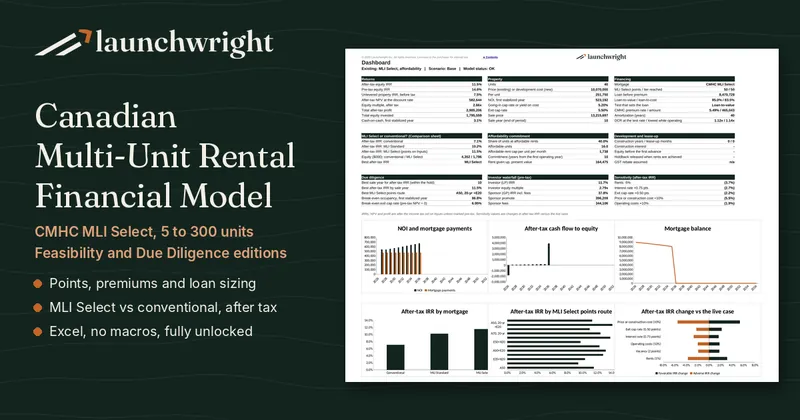
Take the default example in Launchwright’s multi-unit rental model: a 40-unit Calgary low-rise, bought at a 5.5% cap rate and owned by a corporation. With MLI Select at 50 affordability points, the after-tax equity return is about 11.5%. MLI Standard returns about 10.2%. A conventional mortgage returns about 7.1%. That is one building on one set of assumptions, and your rents, costs and city will move every one of those numbers. What carries over is the method. Run the same building three ways through the same after-tax calculation, and the comparison is exact.
For a smaller building of one to four units, the rules are different again, and I cover them in rental property analysis in Canada.
Before you apply
- Pull your rent roll and your area’s median renter income from CMHC’s table, and price the rent you would give up.
- Find out which lending limit binds on your building at today’s rates.
- Cost at least two routes to the points tier you need.
- Compare MLI Select, MLI Standard and a conventional mortgage after tax, through your planned hold and sale.
- Confirm eligibility, lending value and premiums with your lender. CMHC decides each application, and its rules change often.
This article is general information, not mortgage, tax or investment advice. Confirm the current rules with your lender, CMHC and your accountant.