Insights, Financial models
Canadian startup financial plans and what templates miss
What a Canadian startup financial plan needs on GST/HST, payroll, small business tax, CSBFP loan costs and cash timing, the rules generic templates miss.
By Roman Cintula · · 5 min read

This is for anyone putting together a startup financial plan for a new Canadian business, usually to take to a bank or a CSBFP lender. Most of these plans start from a generic template, and the weak spots tend to be in the same places. Revenue and rent are usually reasonable, and the trouble tends to be in the Canadian rules: when GST/HST registration kicks in, what payroll really costs, how corporate tax works for a small company, what the government-backed loan costs, and the gap between profit and cash. None of this is exotic, but a template written for another country will leave most of it out.
I have raised money for my own ventures for more than 25 years, and in my experience a plan whose numbers do not match how a Canadian business actually pays its taxes and its staff loses a reader’s confidence quickly, however good the idea.
GST/HST registration starts earlier than people think
A business does not have to register for GST/HST while it is a small supplier, and the test is $30,000 of taxable sales in a single calendar quarter or over four consecutive quarters. Founders often read that as $30,000 a year, but a café or a busy service business can pass $30,000 in one quarter quite early on. Under the single-quarter test you stop being a small supplier with the sale that takes you over the threshold, and you charge tax from that sale, so the plan should show the actual month this happens instead of a guess.
There is a good case for registering from day one anyway. A new business spends heavily before it sells anything (fit-out, equipment, furniture, signage), and if it is registered, the GST/HST on those costs comes back as input tax credits. Without registration that tax stays a cost. On a large build-out the refund can be meaningful, and when it arrives depends on your filing period, so a business that files annually can wait a long time for it.
What you sell matters too. Taxable, zero-rated and exempt sales are treated differently, a business with a zero-rated stream can still claim input tax credits on its costs, and the split changes every remittance.
Payroll costs more than the wage
An employee paid $20 an hour costs the business noticeably more than $20 an hour. The employer pays its share of CPP (or QPP in Quebec), including the second tier, CPP2, on earnings above the first ceiling, and employer EI is 1.4 times the employee rate. On top of that come vacation pay, workers’ compensation and, in some provinces, a payroll levy. Together they are often enough to move break-even.
One detail catches owner-operators out. An employee who controls more than 40% of the corporation’s voting shares is not in insurable employment for EI, so no EI premiums are paid on their salary. A template that applies EI to everyone overstates the owner’s payroll cost, while one that pays the owner nothing understates what the business really costs to run, and lenders tend to spot that as well.
How small business tax works in a startup financial plan
An incorporated Canadian-controlled private corporation pays a reduced rate on active business income up to the business limit (9% federal plus the provincial small business rate), with the general rate applying above the limit. The provincial piece varies, so the plan needs to use the right province.
The bigger mistakes are usually about timing. In the early years the business often loses money, and those losses carry forward to shelter later profit. Capital cost allowance spreads the deduction for equipment and leasehold improvements over several years instead of taking it in the year you buy them, and leasehold improvements are written off over the lease term. The rules for faster write-offs change often, so check the current ones with your accountant before you count on them. For a small CCPC that claims the small business deduction and stays under its business limit, the tax balance is due three months after year-end, which means the tax cash leaves well after the profit is booked. A plan that simply applies a flat percentage to each year’s profit will get both the amount and the timing wrong.
What a CSBFP loan really costs
The Canada Small Business Financing Program is how many new businesses borrow for equipment and leaseholds. It is delivered by banks and other lenders in partnership with the federal government, and the lender makes the credit decision. Besides the interest rate, which can be up to prime plus 3%, there is a 2% registration fee on the loan. Of the program’s $1,000,000 term loan limit, no more than $500,000 can go to purposes other than buying or improving real property, and equipment and leaseholds fall within that $500,000.
In the model’s default example, a Calgary specialty café has a start-up budget of $192,700, funded with $100,000 of owner equity, a $150,000 CSBFP loan at prime plus 3% and a $25,000 operating line. The funding is set above the budget on purpose, because the business has costs before it opens and losses while it ramps up, and the plan has to carry those too. Debt service coverage in the example is at least 2.46x from year two, which is the kind of figure a lender will look for.
Why a profitable startup can still run out of cash
A business can show a profit in its first year and still run out of money, and the reasons nearly always come down to timing: opening costs paid before the first sale, inventory bought before it is sold, GST/HST paid on purchases before the refund comes in, loan payments that start whether or not sales have, and corporate tax due after year-end.
The figure I would look at first in a startup plan is the lowest cash balance and the month it happens. In the default example the café opens in month three and EBITDA turns positive in month nine, and every month between those two points draws on equity, the loan or the line of credit. If you know the peak funding need and when it hits, you can size the loan and the line properly and ask for them once, rather than going back to the bank in month seven.
I would build that monthly cash view first, then add the annual statements, break-even and lender ratios. The structure a lender expects is set out in what a lender-ready financial model looks like, and our capital readiness service can review a plan before it goes to the bank.
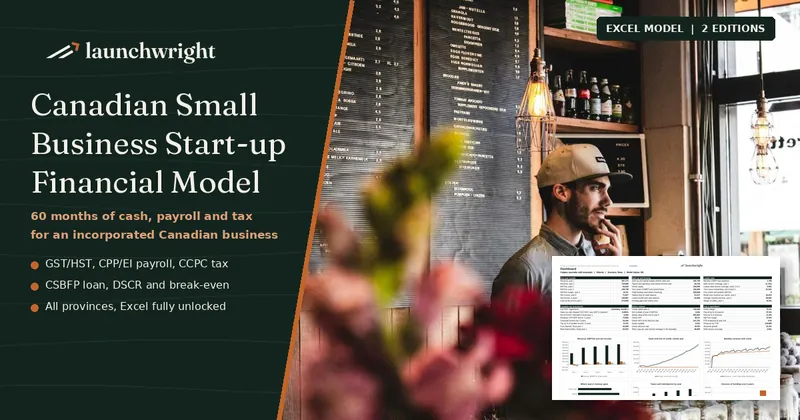
Our Canadian small business startup model applies these rules for every province and territory, and every default can be replaced with your own quotes, lease and offers.
This article is general information, not tax, accounting, legal or lending advice.