Insights, Financial models
BRRRR in Canada: run the refinance numbers first
BRRRR in Canada runs into an 80% refinance cap, seasoning and the flipping tax rule. How to work out a maximum offer that still gets most of your cash back.
By Roman Cintula · · 5 min read

This is for investors weighing BRRRR in Canada: buy a run-down house below value, renovate it, rent it, refinance at the new appraisal and use the cash to buy the next one. Most of the advice online is American, and the Canadian version differs mainly at the refinance and in the tax treatment. It can still work here, but some of your cash will stay in each property, and you need to know how much before you make the offer rather than after.
Why BRRRR in Canada stalls at the refinance
At a bank or other federally regulated lender, a refinance or any uninsured mortgage is limited to 80% of the property’s value. That limit is set by OSFI, the federal regulator. HELOCs are tighter, at 65% of value for the revolving portion.
In the model’s default example, a dated East Calgary bungalow with a legal suite is bought for $365,000 to $380,000, renovated for $55,000 to $65,000, and appraised at $520,000 afterwards. Eighty percent of $520,000 is $416,000, which is already less than the purchase price plus the renovation before land transfer and legal fees, interest while the house sits empty, property tax, insurance and lender fees, so some cash stays in the deal.
Some B and DSCR lenders also size the loan on whether the rent covers the payment, and on a tight deal that test can bite first.
Seasoning, penalties and when the cash comes back
Most Canadian lenders want six to twelve months of ownership (they call it seasoning) before they will lend against a new appraisal. If you refinance earlier, the lender usually caps the loan at the lower of the appraisal and what you paid, which means the value you added with the renovation does not count.
How you financed the purchase matters as well. Break a conventional fixed-rate mortgage to refinance and you pay a prepayment penalty. A private interest-only bridge loan avoids that, but you pay a higher rate plus lender and broker fees for every month you wait out the seasoning. A third route is purchase plus improvements, where the lender holds back the renovation money and releases it when the work is done. I would compare them on timing as well as cost, and model the seasoning period month by month, because a renovation that runs two months late adds two months of carrying costs and pushes the next purchase back by the same amount.
Working backward to a maximum offer
Most investors start with the asking price and ask whether the deal works. I find it more useful to start from the other end. Take a realistic after-renovation appraisal, multiply by 80%, and subtract every cost of getting to that point: the renovation, closing costs, financing fees, interest and holding costs during the work, and any penalty or bridge costs on the way out. Then subtract the cash you are prepared to leave in the deal. What remains is the most you can pay for the house.
If you want every dollar back, that figure will usually be well below asking. Accept leaving $20,000 or $30,000 in and it rises, and either way you have a number to negotiate from and a point at which to walk away.
Use a conservative appraisal, because a low one reduces the refinance while every cost stays where it was.
The Canadian tax rules most calculators skip
Generic templates tend to ignore several Canadian tax rules (more on this in what US rental templates get wrong in Canada). Renovating a run-down property you have just bought is generally treated as a capital cost rather than a repair you deduct this year. Interest and property tax during the renovation are added to the cost of the building as well, so the deductions come back slowly through capital cost allowance, and CCA cannot be used to create a rental loss.
Interest on the cash you pull out at refinance is deductible only for the portion you reinvest in rental property.
The residential flipping rule catches people who change their plans. Sell a residential property you have owned for less than 365 days and the gain is taxed as business income with no capital gains treatment, unless an exception such as death, marriage breakdown or involuntary job loss applies. Holding longer does not guarantee capital gains treatment either, since the CRA can still look at why you bought. A substantial renovation can also trigger the GST/HST self-supply rules, partly offset by the new residential rental property rebate, so speak to a GST/HST adviser before you gut a house.
What the default Calgary plan shows
In the model’s default plan, an investor starts with $200,000 and saves $2,000 a month. Using a private bridge loan, purchase plus improvements and a conventional mortgage across different deals, the plan buys four properties by November 2028. Each refinance at 80% of value recovers 75% to 89% of the cash invested, which leaves between $16,535 and $44,015 in each property. After the refinance, each property earns roughly $267 to $291 a month after setting money aside for capital replacements, with debt coverage of 1.16x to 1.18x.
The after-tax IRR over ten years is 14.7%, counting the sale of all four properties in year 10, and a single property with the refinance cash paid out to the investor comes to 17.1% after tax. That is a good result, though well short of the “infinite return” people talk about online.
I would pay more attention to the debt coverage than the IRR. At 1.16x there is very little room, and a lower appraisal, cost overruns, delays and higher rates arriving together would stall the repeat quickly, so I would never rely on the base case alone. A lender will want to see the downside too (the same applies to any model you put in front of a lender).
Pricing each deal for the cash left in
The investors who get into trouble usually paid as if they would recover all their cash, then found $40,000 still sitting in the house at refinance and had to wait before buying again. Working out the maximum offer before bidding, and budgeting for seasoning, avoids most of that.
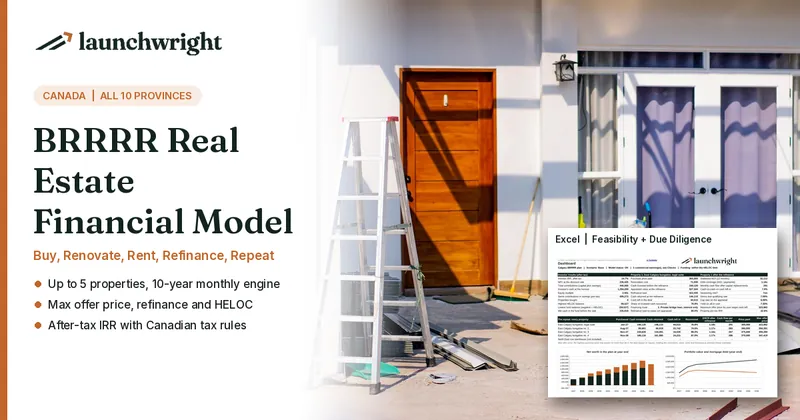
Launchwright’s Canadian BRRRR model runs each property month by month through these rules and calculates the maximum offer price for the amount of cash you are prepared to leave in. If you are raising money from partners for a plan like this, our capital readiness work covers what they will ask for.
This article is general information, not investment, tax or mortgage advice.