Insights, Financial models
Salary vs dividend in Canada when you have a holding company
Salary vs dividend in Canada with an Opco and a Holdco: how RDTOH, the CDA, GRIP and the passive income grind change the answer, and why one-year calculators mislead.
By Roman Cintula · · 5 min read

Owner-managers of Canadian private companies ask the same question every year: should I pay myself a salary or dividends? Most of the free calculators online answer it for one year, at one income, with one corporation. Once there is a holding company with an investment portfolio sitting beside the operating company, that answer can point the wrong way. The salary vs dividend decision in Canada becomes a question about tax pools, the passive income rules and how much you will have after both corporations are eventually wound up. This article explains the moving parts in plain terms. It is not tax advice, and the rules described are general.
Why the one-year answer misleads
Canada’s tax system is designed around a principle called integration: in theory, income earned through a corporation and paid out to you should bear roughly the same total tax as income you earned personally. In practice integration is imperfect and varies by province, so in some years and provinces dividends come out slightly ahead and in others salary does.
The bigger difference is timing. Business income eligible for the small business deduction is taxed in the corporation at a rate far below top personal rates, and personal tax is paid only when the money comes out. That deferral can grow for years inside a holding company. A one-year comparison ignores it, and it also ignores what happens to the tax pools the corporations build up along the way.
What salary buys you
Salary is a deductible expense for the operating company, so it is taxed only once, in your hands. It also creates RRSP contribution room (18% of the previous year’s earned income, up to the annual limit) and requires CPP contributions from both you and the corporation. For 2026 the CRA set the first earnings ceiling (YMPE) at $74,600 and the second (YAMPE) at $85,000, so a salary at or above $85,000 maximizes both CPP tiers.
Some owners see CPP as a cost. It buys a pension indexed to inflation, which is worth something that a wealth comparison in dollars does not capture. Employment insurance is a different case: an owner who controls more than 40% of the voting shares, directly or through a holding company, is generally not insurable, so EI premiums do not apply.
What dividends and the holding company bring
Dividends are paid from after-tax corporate income and come with a gross-up and dividend tax credit designed to account for the corporate tax already paid. Eligible dividends, paid from income taxed at the general corporate rate and tracked in the general rate income pool (GRIP), get a richer credit than non-eligible dividends paid from income that benefited from the small business rate.
A holding company adds three more pools. Investment income earned in a corporation is taxed at a high rate, but part of that tax is refundable: it is tracked in refundable dividend tax on hand (RDTOH) accounts and refunded at 38 1/3% of taxable dividends paid out. Portfolio dividends a corporation receives attract Part IV tax at the same 38 1/3%, which is also refundable. The non-taxable half of capital gains goes into the capital dividend account (CDA), which can be paid out to shareholders tax free by election. The order in which you pay dividends from these pools changes how much tax is recovered and how much you pay personally.
The passive income grind
Since 2019, a Canadian-controlled private corporation’s access to the small business limit (federally $500,000 of active business income) shrinks once its associated group earns more than $50,000 of passive investment income in the previous year. The limit falls by $5 for every $1 above $50,000 and disappears at $150,000.
This is where a holding company with a growing portfolio can work against you. Because the operating company and the holding company are associated, Holdco’s investment income can push Opco’s active income out of the small business rate. Ontario and New Brunswick did not adopt the grind for their provincial small business rates, so the effect differs by province. Keeping more profit in the corporate group to defer tax can therefore raise the tax rate on the business itself a few years later.
Comparing strategies on equal terms
To compare pay strategies fairly, each has to fund the same household spending every year. Otherwise a strategy that pays you less looks better simply because more money is left in the corporation. The comparison also has to run to the end, including the personal tax due when the corporations are eventually wound up, or the deferral strategies will look better than they are.
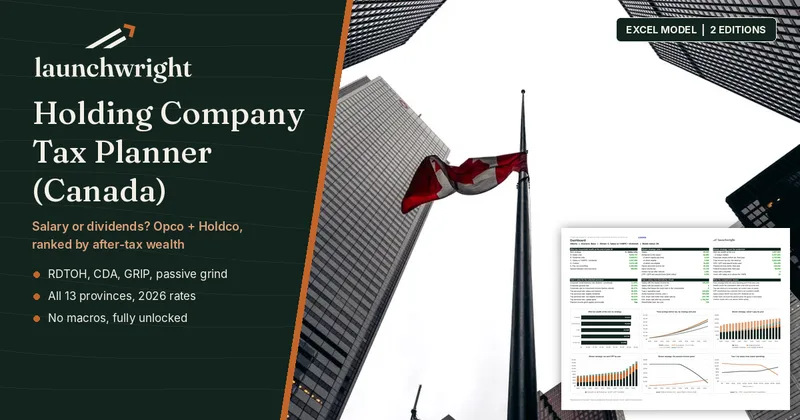
That is how Launchwright’s holding company tax planner is built. For each year and each strategy it solves the salary or dividend needed to fund your after-tax spending, follows the money through Opco, Holdco and your personal accounts, and ranks the strategies by after-tax household wealth after wind-up, in all 13 provinces and territories at 2026 rates. On its default case, an Alberta owner whose company earns $300,000 before pay, with a $250,000 Holdco portfolio and $120,000 of after-tax spending, salary only and dividends only finish within 0.2% of each other after 20 years. Change the province, the portfolio size or the horizon and the ranking can change.
The narrow gap in the default case is the useful result. For many owners the choice between salary and dividends matters less than the confident one-year answers suggest, while the passive income grind, RRSP room and how dividends are sequenced through the tax pools matter more.
Family members and selling the business
Paying dividends to a spouse or adult children can lower the family’s total tax, but the tax on split income (TOSI) rules apply the top personal rate to many such dividends unless an exclusion is met. Selling the business raises separate questions, such as whether a share sale qualifies for the lifetime capital gains exemption and how the alternative minimum tax applies. These are areas where the details decide the outcome and professional advice is essential.
If you are planning a new venture’s structure from the start, the Canadian small business startup plan covers the first five years, and structuring decisions are part of our strategy and project development work.
This article is general information, not tax, legal or investment advice. Tax rules and rates change with each budget. Have any plan reviewed by a qualified tax adviser before acting on it.