Insights, Financial models
Airbnb rental arbitrage: the most rent you can afford
Airbnb rental arbitrage runs on a thin spread. How to find the most rent a unit can carry, get through the first months and test a deal before you sign a lease.
By Roman Cintula · · 4 min read

Airbnb rental arbitrage means leasing an apartment or house you do not own, furnishing it and renting it out by the night or the month. You pay the landlord a fixed rent and keep whatever the guests pay above your costs, so the business lives on the spread between the two, and in most cities that spread is thin. This article is for anyone deciding whether a particular unit, or a portfolio of them, is worth leasing.
AirROI, a short-term rental data provider, looked at two-bedroom listings in ten US markets in its May 2026 analysis of arbitrage unit economics. Its rule of thumb is that monthly short-term rental revenue must be at least 2.5 times the monthly lease for viable margins, and it found that most urban markets fall well below 2.0 times. An average unit in an average city will usually fail that test, so the work is in finding the units that pass it before you sign anything.
Check the local rules and the lease first
Short-term rental rules are set city by city, and many cities restrict short-term rentals in ways that make arbitrage difficult or impossible. The model’s source list names most of British Columbia and Toronto among the places where it is effectively banned, along with several large US cities. Rules also change, and a city can tighten them in the middle of your lease.
The lease matters as much as the bylaw. You need the landlord’s written consent to sublet on short-term platforms, and the building’s own rules may prohibit it regardless of what the landlord says. I would not spend money furnishing a unit on a verbal yes.
The most rent an Airbnb arbitrage unit can carry
The figure you want to take into a negotiation with a landlord is the most rent the unit can carry. Start with what the unit can realistically earn in a month: nightly rate times occupied nights, plus cleaning fees. Take off the platform fee (Airbnb’s host-only fee is 15.5%, Vrbo’s 8%), the cleaner for each turnover, guest supplies, utilities, internet and software, insurance, permits, a repair and damage allowance, and any co-host fee. Then take off the profit you want from that unit. Whatever is left is the most rent you can pay.
If the landlord’s asking rent is above that figure, you can negotiate it down, propose a different structure or walk away. Some landlords will accept a lower fixed rent plus a share of revenue, or a pure revenue share, which moves part of the risk onto them. Where short stays are restricted, mid-term rentals of 30 nights or more are another option, at lower rates but with fewer turnovers.
Run the same sum the other way and you get break-even occupancy, the occupancy at which the unit earns nothing. If that number is close to what similar listings already achieve, you have no margin for a slow winter.
The first three months and the lease clock
A new listing has no reviews, so it usually needs a few months at lower occupancy and introductory prices before it reaches its normal rate, and you pay full rent throughout. You also have the furniture, the deposit held by the landlord and possibly a month or two of free rent while you set up, if you negotiated it. Together these are the cash you have at risk in each unit.
Arbitrage leases typically run one to three years, with rent going up at each anniversary. A unit that clears its costs comfortably in year one can be marginal in year two if the rent rises faster than your nightly rate, which is why I would model each unit on its own lease dates rather than treating the portfolio as one average.
What the default San Antonio portfolio shows
The model’s default portfolio is ten units in San Antonio, six 2-bedroom apartments and four 3-bedroom houses, signed one a month from January 2027. They are leased slightly below average market rents and run at a better nightly rate and occupancy than the typical listing.
The unit-level figures are the most useful part. A well-chosen 2-bedroom earns $786 a month before overhead, compared with $243 for a market-average 2-bedroom. The selected unit breaks even at 43.2% occupancy and can carry rent of up to $1,502 while still earning $400 a month. Run the same ten-unit portfolio with market-average units instead and it returns -3.0% and never pays back.
With the selected units on fixed leases, year-2 revenue is $545,546 and EBITDA $108,153, a 19.8% margin. The owner puts in up to $171,350 and earns an after-tax IRR of 43.5% over five years, with payback in month 30.
That return depends heavily on the assumptions holding. Occupancy 10 points lower cuts the owner’s NPV by $137,583, and a city rule change that moves half the units to stays of 30 nights or more from month 13 cuts it by $175,352. Neither is an unusual event in this business.
When rental arbitrage can work in Canada
On carefully selected units, in a city that allows it and with a landlord who has agreed in writing, arbitrage can earn a good return. As a volume play on average apartments it generally does not, and it is not passive in either case. You are running a small hospitality business with a lease liability on every unit, and the landlord, the city and the platform can each change your economics.
Canadian options are narrower than American ones, given how many of the larger markets restrict short-term rentals. The model includes Calgary as its Canadian market, but wherever you are, confirm the local rules yourself before relying on them. If you also own rentals, the long-term rental rules in what US rental templates get wrong in Canada are a useful comparison.
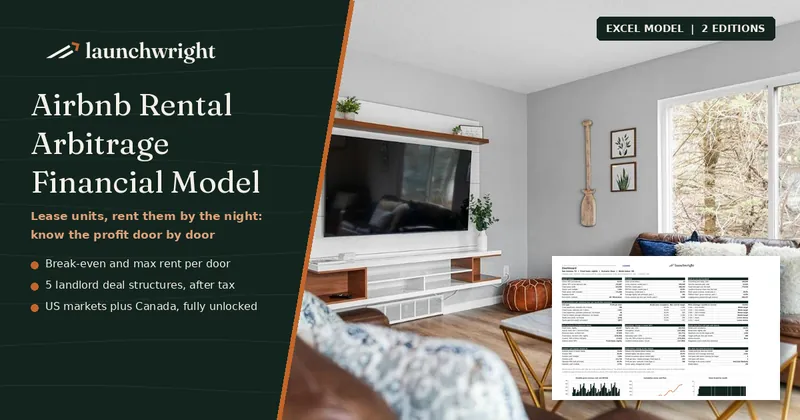
Launchwright’s short-term rental arbitrage model runs a portfolio unit by unit, month by month, and shows the break-even occupancy and maximum rent for each unit type before you negotiate. If you are raising money from an investor for this, a lender-ready model covers what they will look for.
This article is general information, not investment, tax, legal or real estate advice.