Insights, Financial models
Used oil re-refining plant economics by technology
How used oil re-refining routes compare, from Group II and III base oil to distilled fuel and recycled fuel oil, and what each needs in capital and feed.
By Roman Cintula · · 5 min read

A used oil re-refining plant lives on the spread between what its products sell for and what its used oil costs to collect or buy. Before you can estimate that spread you have to decide which oil products the plant will make, and at what quality.
All seven routes below turn used oil into an oil product, and they differ in how far they process it. Re-refining takes it back to lubricant base oil, graded under the American Petroleum Institute (API) system: Group I has less than 90% saturates or more than 0.03% sulphur, while Group II and Group III have at least 90% saturates and no more than 0.03% sulphur, with Group III also above 120 on viscosity index. Reprocessing takes the oil to a fuel instead, anywhere from a filtered burner fuel to a diesel-range distillate.
Used oil re-refining routes and the oil each produces
Almost every plant first removes water and solids and strips off light ends (solvents and light hydrocarbons).
- Hydrotreating to API Group II. Vacuum distillation or a thin-film (wiped-film) evaporator separates a lube-range distillate, vacuum gas oil (VGO), from a heavy residue holding most of the additives, metals and dirt. The VGO is hydrotreated over a catalyst to remove sulphur, nitrogen and oxygen compounds, then fractionated into base oil grades and a smaller fuel stream. The residue is usually sold as asphalt flux. This is the model’s default route.
- Full hydroprocessing to Group II+ or Group III. A more severe scheme of the kind UOP licenses as HyLube (Puraglobe in Germany runs HyLube for Group II and the related HyLubeSAT for Group III) raises the viscosity index further, at the cost of more hydrogen and more capital. Whether a given used oil reaches Group III depends on its quality.
- Solvent extraction with NMP or propane. Propane dissolves the base oil and leaves an asphaltic residue carrying the additives. NMP pulls aromatics, especially polycyclic aromatics, out of the distillate. The product is generally Group I, reaching Group II only with hydrofinishing after it.
- Thin-film evaporation with clay finishing. Clay adsorbs polar compounds from the distillate and improves its colour, odour and stability. With no hydrogen the capital is lower, but the base oil is Group I quality at best and spent clay has to be disposed of. Environment and Climate Change Canada notes that Canadian re-refineries do not currently use clay treatment.
- Vacuum distillation to marine diesel or VGO-grade fuel. This is the front end of route 1 without the hydrotreater, with the distillate sold as a marine diesel blendstock or as VGO to a refinery or fuel buyer.
- Thermal or catalytic cracking to diesel-range fuel. Heat, with or without a catalyst, breaks heavy molecules into lighter ones, and published studies report diesel-like fractions of around 60% of the feed, usually needing further treatment before the fuel meets a diesel specification.
- Recycled fuel oil. The oil is heated, settled to drop out water and sludge, and filtered, with no distillation. The product is a heavy burner fuel for industrial users. The UK calls it processed fuel oil, and ASTM D6448 is a specification for industrial burner fuels made from used lubricating oils.
Most plants sell more than one of these products. Crystal Clean says oil that fails acceptance testing at its Indianapolis re-refinery goes out as recycled fuel oil.
Choosing a product slate, its quality and its buyers
I would start from who you want to sell to and what quality they accept, then work back to what that quality costs to make from the used oil you can actually collect.
Base oil goes to lubricant blenders, who test against API and ILSAC standards and, for the better grades, may want OEM approvals before committing to volume. Each step up in grade brings more hydrogen, catalyst and skilled staff, and the hydroprocessing routes are fussier about feed. Metals poison hydrotreating catalysts, so the oil has to be demetallized first, and a 2013 review of European re-refining recommends keeping ester-based synthetic oils out of feed for hydrofinishing. A variable collected supply shows up in the model as pretreatment and catalyst cost.
Fuel routes cost less to build and run, but fuel generally sells for less than base oil and its price follows the fuel market.
When you compare routes, hold plant size, feedstock cost and market constant and look at EBITDA, capital cost per cubic metre and pre-tax return, since a cheaper product can come out ahead on a much cheaper plant. In the model’s default example base oil is 64% of the feed, and the rest leaves as distillate, asphalt flux, light ends, water, residue and losses, so the volume balance should close every year.
Collection and stewardship set the feedstock cost
You can run your own collection fleet, paying generators for their oil or charging them to take it away, or buy from independent collectors at a delivered price, and many plants do both. Which way the money flows at the generator moves with oil prices.
Stewardship return incentives add revenue, and the model’s Western Canada preset is built on Alberta’s used oil stewardship program. If the project only works with the incentive, tell investors early (see what investors check before your first meeting). The number to aim for is net feedstock cost per cubic metre after collection, purchases, pickup fees and incentives.
Base oil prices and the default example
The default example prices Group II base oil at US$3.00 per US gallon, near the 2025 US average and below the 2026 price spike, and I would hold any plan to that standard. For a lender, I would show the base oil price at which project NPV is zero and how far feedstock costs can rise before value is lost.
The default plant is a 60,000 m3 a year (about 15.9 million US gallons) hydrotreating re-refinery in Alberta at 90% utilization, with total capital cost of about US$42 million (C$59 million) in 2026 prices, checked against built North American re-refineries. The lender-facing structure is set out in what a lender-ready financial model looks like. Technology and feedstock questions are part of our recycling project development work.
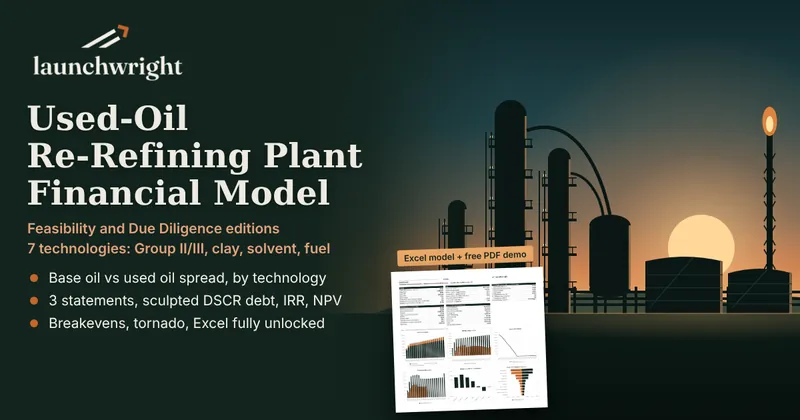
Launchwright’s used oil re-refining model compares all seven routes at the same plant size and runs the one you choose through a full annual model, with Western Canada, United States and custom market presets.
This article is general information, not investment, engineering or regulatory advice.