Insights, Financial models
Tire recycling plant economics: three business models, not one
A crumb rubber plant can take whole tires, TDF chips or mulch. Each route changes revenue, equipment and risk. How to compare them before committing capital.
By Roman Cintula · · 4 min read

People talk about “a tire recycling plant” as if it were one business. It is at least three. What you accept at the gate decides how you get paid, what equipment you need, how many people you employ and how much capital you have to raise. Choose the feedstock route first. Most of the other decisions follow from it.
Whole tires pay you to take them
A plant that takes in whole scrap tires is usually paid to receive them. The money comes either as a tipping fee charged to whoever delivers the tires or, in provinces with a tire stewardship program, as processing and transportation incentives paid per tire or per tonne. On this route, feedstock is income rather than a cost.
You pay for that income with the full front end. Primary shredding, secondary shredding, steel removal and fibre separation all have to happen before you make any crumb. That means the most equipment, the most power, the most wear parts, the largest building and the most staff of any route. It also leaves you the most exposed to the rules of the stewardship program or the local tipping fee market. Your revenue depends on terms someone else sets.
Buying chips or mulch instead
Tire derived fuel (TDF) chips arrive already shredded and partly cleaned, so a plant that buys them skips the primary shredder. Capital and operating costs fall. The catch is that feedstock is now a cost, and you depend on a supplier’s quality and volume. Your business is the margin between what you pay for chips and what you get for crumb, steel and fibre.
Rubber mulch takes that one step further. A plant that buys mulch needs only the final crumb line, which makes it the smallest and cheapest plant to build and run. It is also the most exposed to feedstock price and supply. It suits an operator adding crumb capacity to an existing business better than it suits a standalone project.
Where the revenue comes from
Only the whole tire route earns tipping fees or stewardship incentives. Every route can sell coarse and fine crumb, priced by mesh size and cleanliness, and you can sell some rubber mulch before the final grind if you choose. Recovered steel wire sells as scrap. Fibre is the awkward one. Depending on your market, it may be a product or a disposal cost.
The mix matters as much as the prices. Fine crumb usually sells for more than coarse, but it takes more energy and wear to produce, so the higher price does not automatically give you the better margin. Steel is a meaningful revenue line on the whole tire route and much smaller on the others.
Questions to answer before you pick a route
- Is there a stewardship program, and will it pay you? In stewardship provinces, the incentive per tire can decide the project. Confirm eligibility, rates and how long they are committed.
- Who buys your crumb, at what mesh and on what terms? Offtake for crumb rubber is the same problem as offtake for any recycling project: price, volume, specification and term.
- What does your feedstock supply really look like? Whole tires need collection contracts. Chips and mulch need a reliable supplier.
- What does each route cost to build and run where you are? Power prices, labour and building costs differ widely.
- How will you finance it? Lenders size debt to cash flow, so the route with the most stable revenue may support more debt even if it costs more to build.
Compare the routes on the same assumptions
You can only choose well if you model all three routes on the same footing, with the same market prices, the same financing terms and the same tax rate. Then you can see which route earns the best return on equity, which one carries the most risk and how much debt each can support at a target debt coverage ratio. A whole tire plan built on one set of prices, set against a mulch plan built on another, tells you very little about which is the better business. Common assumptions also let you change one input, such as the crumb price or the stewardship rate, and watch how each route responds.
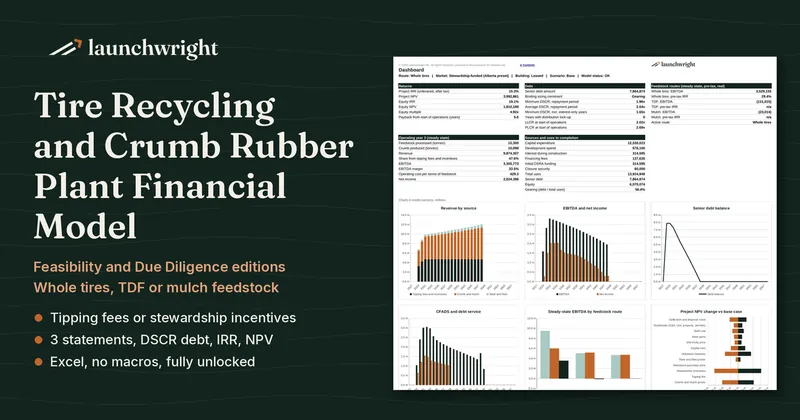
Launchwright’s tire recycling model is built this way. Pick a route and every sheet follows it, while a routes sheet shows all three side by side. It includes a stewardship-funded preset built from a published Alberta incentive program, a gate-fee preset for the United States and a column for your own market.
If you are also weighing pyrolysis as the next step after crumb, read Tire pyrolysis feasibility: five questions to answer first.
This article is general information, not investment or engineering advice. Confirm stewardship rules, market prices and equipment costs for your own project.