Insights, Financial models
How a Canadian MIC works and what to model first
How a mortgage investment corporation earns its yield, the section 130.1 tests that keep it a MIC, and the numbers to model before you raise a dollar.
By Roman Cintula · · 5 min read

A mortgage investment corporation is a tax structure first and a lending business second. If it passes the tests in section 130.1 of the Income Tax Act, it can deduct the dividends it pays out, so income flows through to investors and is taxed in their hands, not at the corporate level. If it fails, it is taxed like any other corporation, and the yield investors were promised shrinks.
I was part of a team that syndicated more than $100 million of Alberta commercial real estate, and what carries over to a MIC is that the deals are only half the work. The other half is the structure the money sits in, and whether it still holds in year three, once the fund is bigger and a few borrowers have stopped paying.
How the money moves through a MIC
Shareholders put in capital, the fund lends it out as mortgages and earns interest and lender fees, and because a MIC pays out 100% of its income, the dividend is whatever remains after interest on any borrowing, management and servicing costs, and credit losses.
The timing rarely lines up neatly, since capital comes in lumps, good loans turn up when they turn up, and cash waiting in the bank pulls the yield down. In the model’s default example, a new Alberta MIC with a $5,000,000 first close earns a net yield of 5.0% in year one, while it is still deploying capital, and 10.1% by year five on the same lending terms, mostly because more of the money is out on loan by then.
The default example uses a weighted lending rate of 10.02% and a 2.13% lender fee, spread across residential first and second mortgages, construction, commercial and land loans. Changing that mix moves the yield and the risk together.
The section 130.1 tests that keep it a MIC
The tests have to hold all year, every year, and a growing fund can drift out of them without anyone noticing. The ones that shape the plan are these:
- At least 20 shareholders, and no shareholder holding more than 25% (there is a deeming rule for the first year)
- At least half of the fund’s assets in residential mortgages and deposits, measured on cost amounts
- Borrowing within 3:1, or 5:1 when at least two-thirds of assets qualify
- Conditions on real property and other matters
Each test runs into a business decision: a sponsor who wants a large share of the first close hits the 25% limit, commercial and land loans pay more but count against the residential test, and a credit facility adds yield along with leverage. I would check every test monthly, since they apply throughout the year.
The default example keeps plenty of headroom, with a residential share of at least 75.8% and leverage of at most 0.39:1 against limits of 50% and 3:1. That room lets the fund take a good commercial loan or draw on its line without risking its tax status. I would also put a figure on what losing status would cost, which the default example does using Alberta’s 23% general corporate rate.
Where MIC credit losses come from
Many first-draft MIC plans put in a default rate and stop there, but a default only becomes a loss to the extent the property fails to cover what is owed, and the size of that loss depends on what the property sells for at enforcement, how much the fund lent against it, whether another mortgage ranks ahead, and what it costs to sell.
A second mortgage carries a different risk from a first at the same loan-to-value, because the first lender is paid before the second. Loss given default should be worked out from those inputs segment by segment, using the combined loan-to-value. Defaulted loans also stop paying interest while they work through enforcement, so the yield suffers before any write-off appears.
In the default example’s base case, credit losses average 0.53% of loans a year. The downside scenario doubles defaults, deepens the property value decline, squeezes the lending margin and slows the raise, and the year five yield falls from 10.1% to 7.7%. A careful investor will usually ask what drives that gap, and the downside assumptions should be easy to find.
Every loan should also be checked against Canada’s criminal interest rate of 35% APR, which a short loan with a high rate and a large upfront fee can approach more closely than people expect.
Leverage, fees and the manager
A credit facility lets the fund lend more than its equity and earn the spread. In the default example it opens in month 13 at prime (4.70%) plus 1.00%, advances against eligible first mortgages and is capped at 35% of NAV. I would calculate the borrowing base from the loan book each month rather than assume a facility amount.
Manager fees need the same detail: a management fee on NAV, assets or the loan book, sometimes a performance fee over a hurdle, and sometimes a share of the lender fees. All of them come out of the investor’s yield. The manager should model its own profit and loss as well, because a small fund may not earn enough in fees to cover the manager’s costs, and the break-even NAV is better known before launch than discovered in year two.
What to settle before you raise capital
Raising capital for a MIC is regulated, and it needs a securities lawyer and a registered dealer where one is required. A financial model does not replace either, though it can show whether the business you are describing works.
I would want answers to a few questions first. How fast can you lend, given your real deal flow, and how much cash drag will the raise create? Does the fund pass every s.130.1 test in every month of the plan, including in the downside case? And what does an investor actually earn after fees and losses? In the default example, $100,000 invested at the first close and redeemed after five years earns an IRR of 8.62% with dividends reinvested, or 8.32% taking cash, which is noticeably below the headline year five yield. A second opinion on these answers before you approach investors is what our capital readiness service is for.
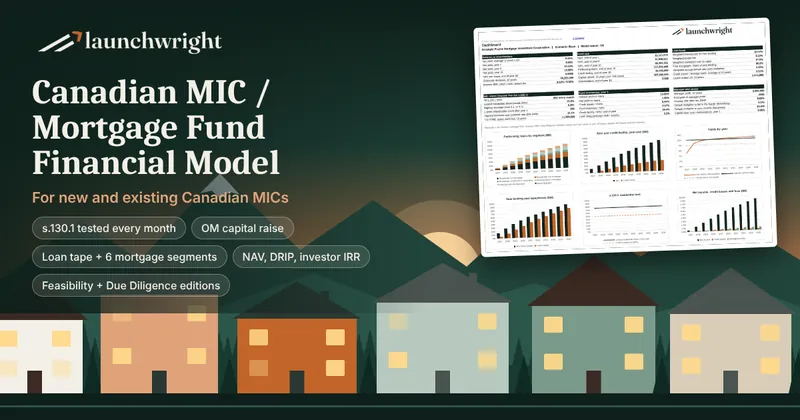
Our Canadian MIC financial model runs these tests month by month and can take an existing fund’s loan tape. Whatever you use should be easy for a reviewer to follow, as described in what a lender-ready financial model looks like.
This article is general information, not tax, legal, securities or investment advice.