Insights, Financial models
E-waste recycling business economics: where the money is
E-waste recycling business economics: gate fees, state program payments, circuit board and metal value, ITAD resale and the labour costs that sink most plans.
By Roman Cintula · · 4 min read

Electronic waste is growing faster than almost any other waste stream. The UN’s Global E-waste Monitor 2024 reported a record 62 million tonnes generated worldwide in 2022, up 82% since 2010 and projected to reach 82 million tonnes by 2030. Only 22.3% was documented as formally collected and recycled. The report valued the metals contained in that year’s e-waste at about US$91 billion. Numbers like these make an e-waste recycling business look like an obvious opportunity, but most of that value is hard to recover profitably, and the economics depend on details that broad market figures hide.
Four ways an e-waste plant earns money
An electronics recycler can earn from four sources. Gate fees are charged to businesses and institutions to take their equipment, especially items that cost money to process, such as CRT monitors. Program payments come from state or provincial schemes that pay recyclers per pound or per tonne for covered devices. Commodity sales cover what the plant recovers: steel, aluminum, copper-bearing material, circuit boards in several grades, hard drives and plastics. And IT asset disposition (ITAD) means wiping, refurbishing and reselling working equipment for corporate clients, usually with a revenue share, plus fees for certified data destruction.
The mix decides the business. A plant that only recycles relies on fees and commodity prices. A plant with an ITAD business earns much more from each working laptop or server it resells than from shredding it.
Program payments vary by state
Where a program pays for covered devices, it can carry a plant. California’s covered electronic waste program is the best-known example. CalRecycle’s published rates set a recovery payment to collectors of $0.40 a pound from July 1, 2025, and combined recovery and recycling payment rates of $1.19 a pound for CRT devices and $1.16 a pound for non-CRT devices as of the end of 2025. Other US states run manufacturer-funded extended producer responsibility (EPR) programs instead, where recyclers are paid under contracts with manufacturers or their organizations, and many states have no program at all.
Canadian provinces run their own electronics stewardship programs, with their own rules on who is paid and how much. A business plan has to be built on the program in the market where the plant will operate, with its current rates and contract terms, and not on an average.
Device mix and the mass balance
Different devices contain very different materials. Servers and networking gear are rich in high-grade circuit boards. Flat-panel displays contain LCD panels and relatively little value. CRT monitors contain leaded glass that costs money to manage. Small consumer electronics are mostly plastic and low-grade boards. A plant’s revenue per pound depends on which devices it receives, so a plan should split intake by device category, convert each into the material fractions it yields, and close a mass balance showing that every pound was sold, sent to a licensed downstream processor or landfilled.
Batteries need separate handling. Lithium batteries in mixed electronics create fire risk in collection, storage and shredding, which affects equipment choice, insurance and operating procedures.
Manual or mechanical processing
Processing ranges from manual demanufacturing, where workers take devices apart by hand and separate components, to shredding and mechanical separation. Shredding processes far more material per worker, but it mixes circuit boards with other materials and reduces the price they fetch, because buyers pay most for clean, sorted boards. Manual work recovers more value per pound and costs much more in labour.
Labour is the cost that sinks many e-waste plans. Hand disassembly is slow, and wages are a large share of operating cost, so the processing choice should be tested against local wages, the device mix and board prices. Hybrid lines, with manual pre-sorting to pull out high-value components before shredding, are a common compromise.
Certification and data security
Corporate and institutional clients usually require recyclers to hold a recognized certification, such as R2 or e-Stewards, and to follow a recognized data sanitization standard, such as NIST SP 800-88, before they will send equipment. Certification adds cost and time before launch, and without it access to the most valuable ITAD work is limited.
Testing the economics
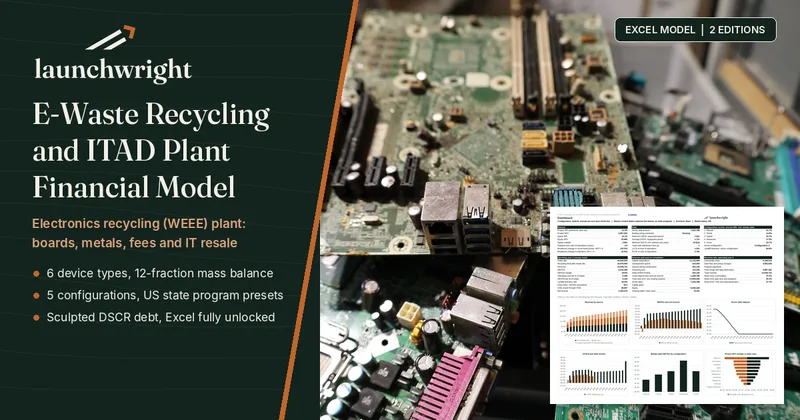
Launchwright’s e-waste recycling plant model splits intake into six device categories and twelve material fractions with a mass balance, compares five processing configurations at the same plant size, and includes presets for a US market with gate fees only, California’s program, a manufacturer-funded EPR state and your own market. The optional ITAD module adds device resale, client revenue share, refurbishment costs and data destruction fees. At its defaults (a hybrid line in the US national market processing 30 million pounds a year), the Due Diligence Edition shows a project IRR of 13.3% after tax and an equity IRR of 15.1%. With the ITAD module switched off, the same plant does not pay back, and below about 28 million pounds a year the default plant no longer earns its cost of capital.
That result is the main lesson for anyone planning an e-waste plant: a fee-and-commodity recycler without program payments or ITAD revenue has very thin margins. Confirm where the higher-value revenue will come from before committing to a plant. For how recycling projects are financed and what lenders test, see what a lender-ready financial model looks like and our project development work.
This article is general information, not engineering, investment or legal advice. Confirm program rates, permits and market prices for your own project.