Insights, Financial models
Construction and demolition waste recycling: plant economics
How a construction and demolition waste recycling plant makes money: gate fees priced against the landfill, recovered materials, residue costs and plant design.
By Roman Cintula · · 4 min read

Construction and demolition waste is the largest waste stream most people never think about. The US Environmental Protection Agency estimates that 600 million tons of C&D debris were generated in the United States in 2018, more than twice the municipal solid waste figure, and that demolition accounts for more than 90% of it. Just over 455 million tons went to a next use, mostly as aggregate, and just under 145 million tons went to landfill. For anyone looking at a construction and demolition waste recycling plant, those numbers point to the opportunity and to the main competitor, which is the landfill down the road.
How a C&D recycler gets paid
A C&D recycler earns money in two ways. Haulers pay a gate fee, also called a tipping fee, to unload at the plant, and the plant sells what it recovers: crushed concrete and brick as recycled aggregate, wood as biomass fuel or mulch feedstock, and metals as scrap. It pays to landfill whatever it cannot sell.
The gate fee usually carries the business. In the default case of our model, gate fees make up about four-fifths of revenue. That makes the competing landfill rate the most important number in the plan, because haulers will only bring their loads to you if tipping at your gate costs them less than tipping at the landfill, after allowing for extra travel.
The landfill sets your price ceiling
Landfill rates vary widely by region, and they can change the answer completely. Calgary is a useful example of how policy can tilt the economics. For 2026 the City of Calgary charges $113 a tonne for basic sanitary waste at its landfills, but loads containing 10% or more of construction and demolition materials (concrete, road asphalt, brick and block, scrap metal, recyclable wood and drywall) pay a disposal surcharge rate of $180 a tonne. A hauler with a mixed demolition load has a strong reason to take it somewhere else, and a recycler can price below the surcharge and still charge well.
In regions where landfill space is cheap, the opposite applies. In our model, the same plant that earns a 12.8% project IRR at US Northeast landfill rates falls below a 9% discount rate at US national-average landfill fees. Anyone assessing a C&D project should confirm local landfill rates, how long they are likely to hold and whether any diversion requirements push material toward recyclers, before looking at anything else.
Three intake streams, ten materials
Mixed C&D loads are the most valuable to receive and the hardest to process. They contain concrete and rubble, wood, drywall, shingles, ferrous and non-ferrous metals, cardboard, plastics, fines and other material, each recovered at a different rate depending on the sorting equipment. Clean loads of concrete, asphalt and brick can go straight to a crusher, and clean wood straight to a grinder, at lower processing cost.
Fines and residue are where many plans go wrong. The material that cannot be sold has to be landfilled at the same rates that make the gate fee attractive, so the recovery rate drives the cost side as much as the revenue side. A model should close a material balance every year, showing that every tonne received was either sold or landfilled, with the cost of each.
Choosing the plant design
C&D plants range from simple to highly automated. A basic plant uses an excavator to pre-sort, a screen, a hand-picking line and a magnet. A mechanized line adds a shredder, disc and star screens, air separation and eddy current separation for non-ferrous metals. An advanced line adds optical sorters and robotic pickers.
More equipment raises recovery and reduces labour, but it costs more to build and maintain, and the gain depends on how much the extra recovered material is worth in your market. The design decision should be made by comparing the configurations at the same throughput, with the same prices and financing, rather than choosing the most advanced plant by default.
What lenders will look at
Lenders financing a recycling plant focus on the stability of the gate fee revenue, the length of hauler commitments, the landfill rate trend and how much margin there is if prices fall. They size debt to cash flow at a target debt service coverage ratio, so a plan with a narrow spread between the gate fee and the cost of residue disposal will support less debt.
Modelling a C&D plant
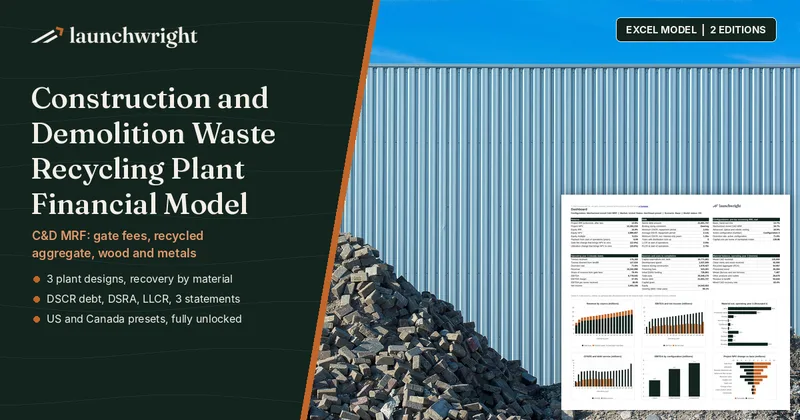
Launchwright’s C&D recycling plant model is built around the gate fee spread. It compares three plant configurations at the same throughput, takes mixed, concrete and wood intake streams, splits mixed loads into ten materials with a material balance, and switches between a US Northeast preset, a Western Canada preset built on Calgary’s 2026 landfill rates and your own market. Gate fees are set as a discount to the competing landfill rate, so you can see how far below the landfill you can price and still earn your return. The Due Diligence Edition sizes debt to a target DSCR and adds scenarios and sensitivities.
For the broader questions of how recycling plants are financed and what lenders expect, see what a lender-ready financial model looks like and our project development work.
This article is general information, not engineering, investment or legal advice. Confirm landfill rates, permits and market prices for your own project.