Insights, Financial models
Gold mine financial model: what lenders test before funding a mine
What a gold or copper mine financial model has to show: mine plan, payable metal, AISC, capital and closure costs, Canadian tax and debt sizing.
By Roman Cintula · · 5 min read

A mine is a wasting asset. It has a fixed amount of ore, it takes years and a large amount of capital to build, and when the reserve is gone the owner still has to pay to close the site. Lenders finance mines regularly, but they test them harder than almost any other project, because there is no second chance to earn back the money once the ore is processed. A gold mine financial model that will be taken seriously has to follow the rock from the ground to the bank account. This article goes through the steps and the tests.
The mine plan sets everything
The starting point is the reserve: how many tonnes of ore, at what grade. The mill’s capacity sets how fast that ore is processed, and reserve divided by throughput gives the mine life. Grade is rarely even. Many mines process higher-grade ore in the early years, which improves early cash flow and debt repayment, and the plan has to stay consistent with the total reserve.
Not all the metal in the ore is sold. Recovery is the share the plant extracts. For gold poured as doré bars, refining charges are small. For copper and copper-gold mines that sell concentrate to a smelter, the smelter pays for only part of the contained metal and deducts treatment and refining charges and freight. A royalty, often a net smelter return paid to a previous owner, comes off the top. Net revenue is what remains.
Costs and the measures investors use
Operating costs are usually built per tonne mined and per tonne milled, plus site administration. Two summary measures let investors compare mines. All-in sustaining cost (AISC) per ounce, a measure introduced by the World Gold Council, adds sustaining capital and corporate costs to the direct cost of production, to show what it costs to keep producing an ounce. For copper, the C1 cash cost per pound, which is the direct cost of producing the metal, serves a similar purpose. A mine whose AISC sits high relative to the metal price has little room if the price falls.
Capital, sustaining capital and closure
Initial capital covers the mining fleet, pre-stripping or underground development, crushing, the process plant, tailings storage, infrastructure on and off the site, indirect costs, the owner’s costs and a contingency. It is spent over several years before the first revenue.
Two later costs are often underestimated. Sustaining capital, such as tailings expansions and equipment replacement, continues through the mine’s life. Closure and reclamation costs fall at the end, when there is no revenue, and regulators generally require financial assurance for them earlier. A model should carry both, and a cash reserve for closure.
Canadian tax is its own subject
Mines in Canada pay federal and provincial income tax and a separate provincial mining tax, and the mining taxes are calculated differently in each province. Capital spending goes into tax pools with different deduction rates, and exploration and development costs have their own treatment. The federal government also offers a 30% investment tax credit for equipment used in extracting and processing certain critical minerals. Copper is on that list and gold is not, so whether a copper-gold mine qualifies depends on how much of its output value comes from the qualifying mineral. These rules can change the after-tax value of a mine materially and need specialist advice.
How lenders size the debt
Mine debt is sized to cash flow. The lender sets a target debt service coverage ratio and shapes repayments so that each period’s payment fits the cash available at that ratio, which matches repayments to the high-grade early years. A reserve tail is usually required, meaning the loan must be repaid while a meaningful share of the reserve is still in the ground.
Lenders also require a debt service reserve account, a test that locks up distributions if coverage falls, and often a cash sweep that repays debt faster when prices are high. The loan life coverage ratio and project life coverage ratio compare the value of future cash flow with the debt outstanding. Every one of these is tested at metal prices well below the base case.
Streams and royalties
Many mines raise part of their capital by selling a stream, in which a financier pays an upfront deposit in return for the right to buy a share of future metal at a fixed low price. A stream reduces the equity and debt needed, and it also reduces the revenue available to repay the lender and reward shareholders for the life of the mine. Its cost is easy to understate, so a model should show returns with and without it.
Metal price is the biggest input
No assumption moves a mine’s value more than the metal price, and nobody forecasts it reliably. The usual practice is to use a consensus price deck for the near years and a long-term price after that, and then to show how value, coverage and returns change as price and capital cost move together. A project that works only at today’s price is unlikely to be financed.
A worked template
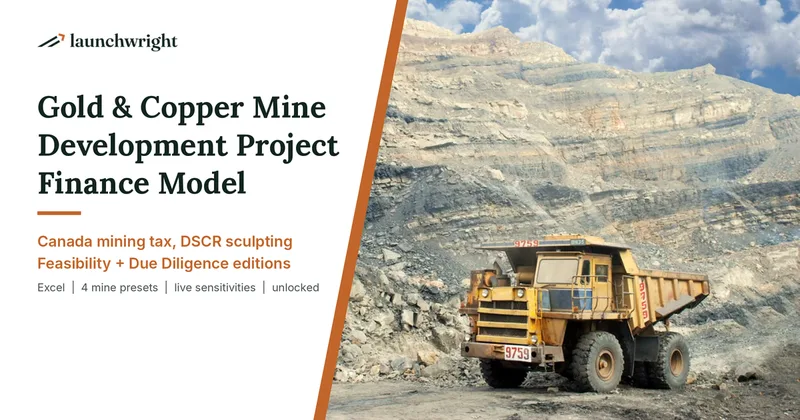
Launchwright’s gold and copper mine development model runs from the first year of construction to the end of closure for open-pit and underground mines, with smelter terms, ten capital lines tagged to Canadian tax pools, the Ontario, Quebec and British Columbia mining taxes, streaming and live sensitivities. The Due Diligence Edition sizes debt to a target coverage ratio with the reserve account, lock-up and cash sweep. Its default case is a 4,800 tonne-per-day Ontario open-pit gold mine based on a published pre-feasibility study, with about C$450 million of initial capital. On those defaults it shows an after-tax project internal rate of return (IRR) of 32.6% and an AISC of about US$1,543 an ounce. Those results depend on a long-term gold price assumption of US$3,300 an ounce and are illustrations.
For why plant budgets grow between the first estimate and the finished project, see pyrolysis plant capital cost. For what a lender expects from a model, read what a lender-ready financial model looks like. Preparing a project for lenders and investors is part of our capital readiness work.
This article is general information, not investment, tax, legal or engineering advice. It is not a technical report, and mineral project disclosure in Canada is subject to its own rules.